Time Sequence
Relative TSEQ
Sometimes it is useful to define time values relative to another audio signal. In that case, the older help content describes a relative time sequence using this form:
[x;][y]
Example 1
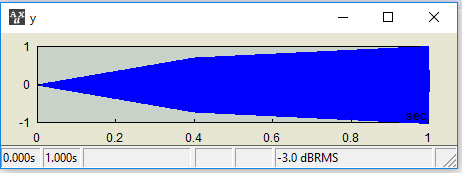
The amplitude of a tone is scaled with a time sequence that is:
0att=00.7att=250 ms0.3att=500 ms1att=1000 ms
The help notes that multiplication with a TSEQ involves linear interpolation between specified time points.
AUX> x = tone(500,1000);
AUX> ts = [0 250 500 1000][0 .7 .3 1];
AUX> y = ts * x;
Example 2
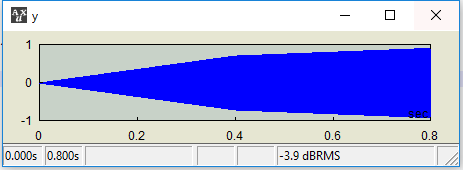
The same TSEQ can be applied to a signal with a different duration:
AUX> x = tone(500,800);
AUX> ts = [0 250 500 1000][0 .7 .3 1];
AUX> y = ts * x;
The older text asks whether this is the desired behavior, implying this example illustrates an absolute rather than relative time course.
Example 3
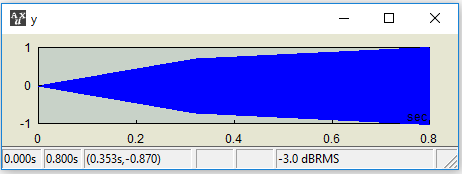
To scale audio with the same relative time course as Example 1, use a relative TSEQ:
AUX> x = tone(500,800);
AUX> ts = [0 .25 .5 1;][0 .7 .3 1];
AUX> y = ts * x;
Example 4
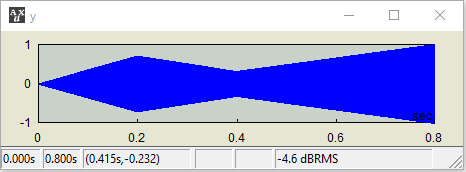
To adjust amplitude using a desired time course in dB, use the @ operator:
AUX> x = tone(500,800);
AUX> ts = [0 .25 .5 1;][-100 -3 -10 0];
AUX> y = x @ ts;
Current source basis:
time_sequence.htmlTimeSequence.html